
As a product leader, it’s tempting to keep adding features to keep up with competitors. But true leadership often means saying “no” to unnecessary features and instead focusing on what truly matters to customers. One excellent example is Netflix, which managed to dominate the streaming space by sticking to a focused product strategy while competitors flooded their platforms with features.
While platforms like Hulu, Amazon Prime, and even traditional cable TV providers tried to win customers by offering everything—from live sports to bundled content—Netflix took a different path. Instead of adding numerous additional features (like live TV or news), Netflix stayed laser-focused on content personalization, ease of use, and a seamless user interface. This approach helped Netflix become the leader in the streaming market by mastering what mattered most to its audience: the best content discovery experience and the most binge-worthy shows.How does Netflix prioritize its features and innovations without getting caught in an endless cycle of feature-chasing? The answer lies in understanding and applying the Jobs to Be Done (JTBD) framework.
To explain why Netflix’s approach worked, we can use the Jobs to Be Done (JTBD) framework. This framework helps identify the core “job” the user hires the product to do. Instead of looking at individual features, the focus is on understanding what problem the user is trying to solve.
Key principles of JTBD:
- 1. Customers “hire” products to do specific jobs in their lives.
- 2. Jobs are about progress, not just tasks.
- 3. Jobs are stable over time, while solutions may change.
- 4. Understanding the job helps predict what solutions will succeed.
Let’s examine how Netflix applies the JTBD framework to compete effectively without chasing every feature its competitors introduce.
1. Define the Job:
Netflix identified the primary job its users wanted to accomplish: easy and enjoyable content discovery and consumption, available on-demand, without friction. It understood that users cared about spending less time searching and more time watching.
2. Prioritize Core Features:
Instead of adding “everything,” Netflix focused on perfecting the algorithm for personalized content recommendations, the simplicity of the user interface, and reliable streaming quality. It doubled down on these core jobs, resisting the temptation to add features like live TV or other distractions.
3. Customer-Centric Innovation:
Netflix innovated not by adding new features, but by improving how users engaged with existing ones—such as automatic next-episode play, personalized viewing suggestions, and interactive content (like “Black Mirror: Bandersnatch”). These innovations further improved the core job that users hired Netflix to do.
4. Market Differentiation:
Netflix became synonymous with binge-watching and content discovery, while other competitors, like Hulu and Amazon Prime, were seen as platforms offering a bit of everything but not excelling at any one thing. By refusing to chase feature parity, Netflix created a unique value proposition that differentiated it from the crowded market.
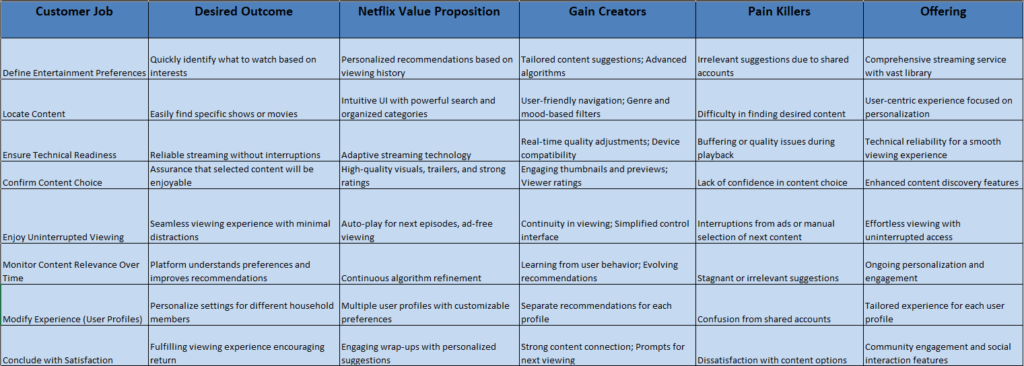
Value map
1. Live Sports: While competitors like Amazon Prime have invested in live sports broadcasting, Netflix has largely avoided this area. Why? Because it doesn’t align closely with their core job of providing on-demand entertainment and escape.
2. News Content: Unlike platforms such as Hulu, which offers live TV options including news, Netflix focuses on scripted and documentary content. This aligns with their job of entertainment rather than information delivery.
3. Gaming (until recently): For years, Netflix resisted entering the gaming market, focusing instead on perfecting their core offering. Their recent foray into mobile gaming is a calculated move that still aligns with the job of providing entertainment.
Position Your Product Using JTBD Framework
As a product leader, here’s how you can apply this approach:
- Focus on the Core Job Your Product Does Best: Identify what your product solves better than the competition. Don’t be swayed by competitors adding dozens of features—prioritize features that enhance the core experience.
- Be Selective with Innovation: Innovate purposefully. For example, if your core job is simplifying data analysis, focus on enhancing visualizations or insights rather than adding unrelated features like CRM or project management.
- Customer-Driven Prioritization: Engage deeply with your users to understand their pain points. Like Netflix, use this insight to continuously refine the experience, ensuring that new features align with solving the key job users need.
This strategy allows Netflix to innovate meaningfully, allocate resources efficiently, and maintain a strong brand identity. As businesses across industries face similar challenges of feature creep and competitive pressure, the JTBD framework offers a valuable lens for focusing efforts and winning the war of priorities.
As Netflix has demonstrated, staying focused on the core job your product does—without being distracted by feature overload—can be the key to winning in competitive markets. Using frameworks like JTBD can help you stay grounded in customer needs, innovate strategically, and position your product to stand out, not by doing everything, but by doing the important things exceptionally well.