In the cutthroat SaaS arena of 2024, the pricing strategy isn’t just a number—it’s the battle cry. With a sea of competitors vying for attention, how does one ensure their product doesn’t just participate, but dominates? Enter the 3C’s framework: Costs, Customers, and Competition. This powerful trifecta, wielded masterfully by giants like Canva, can transform your pricing from a mere afterthought into a magnetic force that attracts customers and repels rivals. Ready to craft a pricing strategy that turns heads and opens wallets? Let’s dive into the art of standing out in a world of sameness.
1. Costs
Do:
Calculate all direct and indirect costs associated with your product
Consider Customer Acquisition Cost (CAC) and Customer Lifetime Value (CLV)
Factor in future development and scaling costs
Don’t:
Underestimate operational costs
Ignore the cost of customer support and retention
Analysis:
Break down costs into fixed and variable components
Determine your break-even point
Set a minimum price threshold to ensure profitability
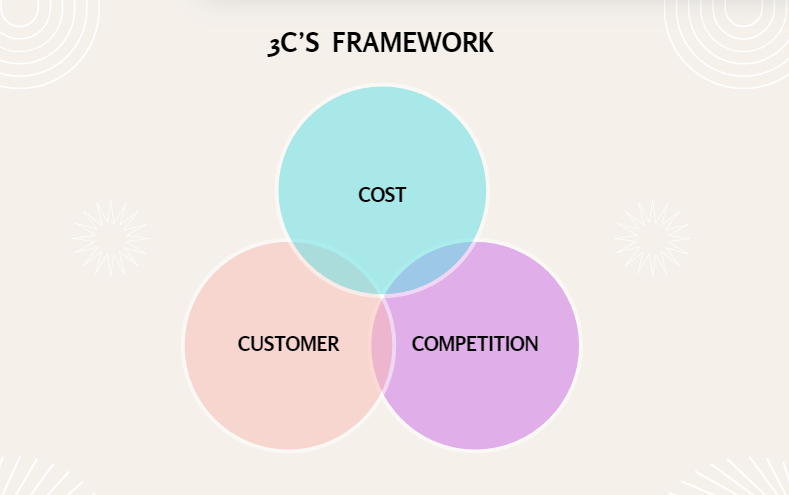
3 C’s Framework
2. Customers
Do:
Segment your target market based on needs, budget, and perceived value
Conduct customer surveys and interviews to understand willingness to pay
Create buyer personas to tailor your pricing strategy
Don’t:
Assume all customers value your product equally
Ignore the specific needs of different market segments
Analysis:
Use techniques like Van Westendorp’s Price Sensitivity Meter
Analyze usage patterns to identify high-value features
Consider the total addressable market (TAM) for each pricing tier
3. Competition
Do:
Conduct a thorough competitive analysis of direct and indirect competitors
Identify your unique selling propositions (USPs)
Monitor market trends and pricing changes in your industry
Don’t:
Blindly match competitor prices without considering your unique value
Ignore potential new entrants or disruptive technologies
Analysis:
Create a competitive positioning map
Identify gaps in the market where you can differentiate
Analyze competitor’s pricing models and feature sets
Now, let’s apply this framework to a real-life example to demonstrate how it can help a SaaS company stand out in the market.

Canva, the graphic design platform, has successfully applied a pricing strategy that aligns well with the 3C’s framework:
1. Costs:
Canva invested heavily in its design library and user-friendly interface
They leveraged cloud infrastructure to scale efficiently
They focused on automating many processes to keep operational costs low
2. Customers:
Canva identified different user segments: individuals, small businesses, and enterprises
They recognized that different customers had varying needs and budgets
They conducted extensive user research to understand the value perception of their tool
3. Competition:
Canva positioned itself against both complex design software (like Adobe) and simpler tools
They identified a gap in the market for an easy-to-use yet powerful design tool
They continuously added features to stay ahead of emerging competitors
1. Freemium Model:
– Offered a robust free tier to attract users and build a large user base
– This helped them stand out from traditional design software with high upfront costs
2. Tiered Pricing:
– Pro plan for individuals and small teams with advanced features
– Enterprise plan for larger organizations with collaboration needs
– This allowed them to cater to different customer segments effectively
3. Value-Based Pricing:
– Priced their Pro plan competitively compared to other design tools
– Emphasized the time-saving aspect of their templates and easy-to-use interface
4. Clear Communication:
– Transparent pricing page highlighting the value of each tier
– Regular updates on new features added to each plan
5. Continuous Evaluation:
– Regularly updated their pricing and plans based on user feedback and market trends – Introduced new features like Canva Print to expand revenue streams
By applying the 3C’s framework, Canva was able to create a pricing strategy that:
– Covered their costs while allowing for rapid scaling
– Catered to various customer segments with different needs and budgets
– Differentiated them from both high-end design software and simpler alternatives
This strategy has helped Canva stand out in the competitive design software market and achieve significant growth. By ensuring pricing reflects both internal cost structures and the perceived value customers receive, while remaining competitive within the market, companies can establish a sustainable pricing model that maximizes both revenue and customer satisfaction. Ultimately, a well-executed 3C pricing strategy not only drives profitability but also helps build long-term customer relationships and a competitive advantage in a dynamic landscape.